How to say it · Out and about

Meeting halfway

They've said no, or named a price you don't like. You don't have to just accept it or walk away: you can suggest something in the middle.

6 ways to say it
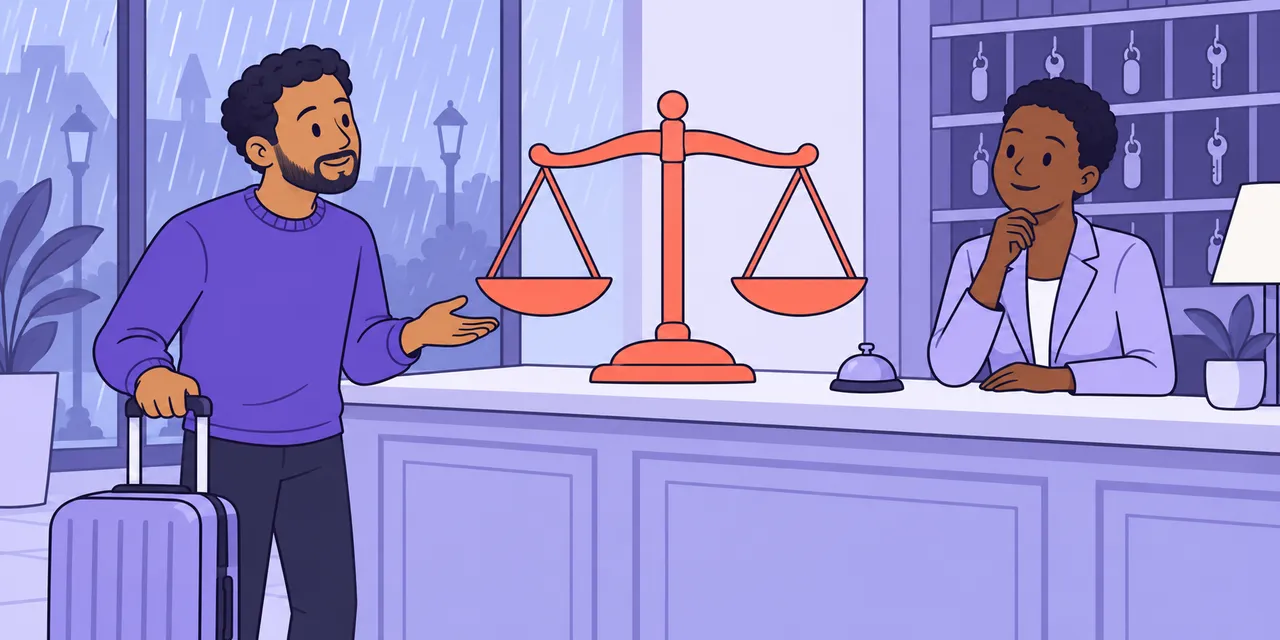
At a hotel reception, Sam with his suitcase makes an offer to the receptionist, a balance scale level between them.
How hard you bargainSoftFirm

Way 1 · best default

How about

Puts a new option on the table, lightly. Easy to say, and easy for them to say yes to.

How hard you bargainSoft
ToneNeutral
Use itAnywhere

Examples

Two's a bit much? How about one o'clock instead?

How about one day at home to start with, and we see how it goes?

In a conversation

A: I'm afraid a two o'clock checkout would be thirty pounds.
B: Hmm. How about one o'clock? Would that be free?

Common mistake

Not: How about to leave at one?

Say: How about leaving at one?

After "how about", use a noun or an -ing verb, never "to": "How about one?" or "How about leaving at one?"
Next: Shall we meet halfway?

Way 2 · split it fairly

Shall we meet halfway?

You both give up the same amount. Fair and friendly, and hard to refuse.

How hard you bargainMiddle
ToneNeutral
Use itAnywhere

Examples

You said fifty, I said thirty. Shall we meet halfway?

Shall we meet halfway and say I'm in three days a week?

In a conversation

A: I can't do less than sixty for the bike.
B: I was thinking forty. Shall we meet halfway? Fifty?

Next: Is there any flexibility?

Way 3 · test the water

Is there any flexibility?

The softest start. You ask if the price or rule can move at all, before you name a number.

How hard you bargainVery soft
ToneNeutral
Use itAnywhere

Examples

Is there any flexibility on the charge for a late checkout?

The rent's a bit high for me. Is there any flexibility?

Common mistake

Not: Please reduce the price for me.

Say: Is there any flexibility on the price?

Asking them to reduce it sounds like an order. A question lets them offer something without losing face.

Next: What if we

Way 4 · offer a trade

What if we

You suggest a new plan where you give something too, so it solves their worry as well as yours.

How hard you bargainMiddle
ToneNeutral
Use itAt work

Examples

What if we fixed my home days, so the team always knows when I'm in?

What if we tried it for a month and then had another chat?

In a conversation

A: My worry is that you'd miss the Monday meetings.
B: What if we made Monday an office day for me, every week?

Next: That works, as long as

Way 5 · yes, with a condition

That works, as long as

You agree, but only if you get something back. Clear and businesslike.

How hard you bargainFirm
ToneNeutral
Use itAnywhere

Examples

Monday at home? That works, as long as I can leave early on Thursdays.

Twelve o'clock? That works, as long as I can leave my bag here till four.

Next: That's the best I can do

Way 6 · final offer

That's the best I can do

You've already moved, and you won't move again. Polite, but it closes the bargaining.

How hard you bargainVery firm
ToneNeutral
Use itAnywhere

Examples

I can do forty-five, but that's the best I can do.

Two days a week, Fridays included. That's the best I can do, I'm afraid.

In a conversation

A: Could you go down to forty?
B: Sorry, I've already dropped it twice. That's the best I can do.

Test yourself: which would you say?
Pick the right one

Which would you say?

Read the moment, then choose the way that fits it best.

Now say it out loud

Pick one and practise it in a real conversation. Save the ones you want to remember.